


Congratulations to Tamsyn Muir and Yoon Ha Lee on their Goodreads Choice Awards 2019 nominations!
Best Science Fiction:
Gideon the Ninth by Tamsyn Muir
Best Middle Grade & Children’s:
Dragon Pearl by Yoon Ha Lee
Congratulations to Tamsyn Muir and Yoon Ha Lee on their Goodreads Choice Awards 2019 nominations!
Best Science Fiction:
Gideon the Ninth by Tamsyn Muir
Best Middle Grade & Children’s:
Dragon Pearl by Yoon Ha Lee
 The Best of Elizabeth Bear by Elizabeth Bear
“From the award-winning author of The Red-Stained Wings (2019, etc.), a collection of 27 tales published between 2005 and 2019, spanning most of Bear’s career. Readers familiar with Bear’s novels soon learn to expect the unexpected, with characters, worlds, and ideas eyed from drastically skewed perspectives. Who else would dream up a lactating vampire to whom the sun is no enemy, as Bear did in “Needles”? Or imagine a mortal Loki, banished from the Norse pantheon, as a god of rock music, as in “Hobnoblin Blues”? Mark Twain makes a guest appearance in a chewy murder mystery, “The Body of the Nation,” set in the author’s remarkable New Amsterdam universe and featuring the splendid Detective Crown Investigator Abigail Irene Garrett. We’re offered an early yet highly effective glimpse of the universe that will evolve into the stunning Steles of the Sky series, “Love Among the Talus,” while “Okay, Glory” shows us a reclusive, solipsistic genius forced to reinvent himself and the AI that’s imprisoning him. Elsewhere, “The Bone War,” Bear’s wry commentary on the real-world Bone Wars between 19th-century paleontologists O.C. Marsh and E.D. Cope, evokes a wide grin. Two tales would wring tears from a stone: “Tideline,” about a dying battle machine whose last purpose is to memorialize her dead crew members, and “Orm the Beautiful,” an exquisitely fashioned fable of the last dragon—that’s also, possibly, a genuflection to Ursula K. Le Guin’s Earthsea tales. While Bear doesn’t preach or hector, there’s a message implicit in much of the work here: As individuals and as a species, we adapt, or we die. Eclectic and insightful, and well worth dipping into.” — Kirkus
Gideon the Ninth by Tamsyn Muir
“Tamsyn Muir’s GIDEON THE NINTH is a devastating debut that deserves every ounce of hype it’s received, despite the bafflingly misleading marketing around it
Everything I read about Gideon the Ninth before publication seemed to suggest it would be a lighthearted wacky adventure, with much made of the tagline “lesbian necromancers in space”—but I experienced the book as meticulous and moody, full of anguish, haunted by difficult and complex feelings in a wasted universe. Muir marshals a gorgeous cast of characters to delirious effect in a perfectly paced haunted house murder mystery, but it’s less gonzo than it is Agatha Christie writing Gormenghast. Muir is fantastic at both humor and horror, not to mention moving me to tears. I should also note that Gideon the Ninth is not a romance, though queer longing abounds; it’s deft, tense and atmospheric, compellingly immersive and wildly original. It’s honestly perfect as both a satisfying stand-alone and the launch of a trilogy, and I can’t wait until the sequel lands next year.” — New York Times
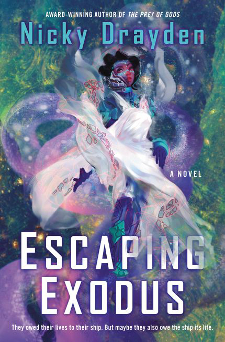 Escaping Exodus by Nicky Drayden
“Nicky Drayden’s novels are weird—and I mean that as the highest of compliments.
Her genre-blending debut The Prey of Gods landed on the scene in 2017 with the self-same subtlety of a Roman candle stuck up your nose. Artificial intelligence and African folklore, mind control and murder, demigods and dik-diks, The Prey of Gods has everything. Her sophomore effort, Temper, an Afrofuturist romp through a world in which your social identity is defined by your balance of vice and virtue, continued in the same audacious vein, plus twice the world-building.
Now comes Escaping Exodus, Drayden’s third novel, as pleasantly and characteristically bonkers as ever. Eschewing her established skill at tossing science fiction and fantasy together in a blender, she leans full into her Octavia Butler fineries and drops us aboard a city-size starship carved in the innards of a drifting space beast.
Seske and Adalla’s relationship is compelling and serves as the framework for all the plot to come (including a few wild tangents that complicate matters significantly), but it is this theme of environmental justice that is the novel’s central concern. As Seske learns to lead, she grapples with the devastating consequences of her people’s way of life to the beast that carries them. Adalla, on the other hand, becomes obsessed with the class inequality that fuels the system. These twin threads feel true enough to our own time, and thoroughly modern, while aligning with science fiction’s long history of climate-focused, socially conscious works.
Both threads are also entwined with one of Drayden’s recurring concerns: the construct of gender and the subversion of its norms. Gender fluidity and explorative sexuality are key components of The Prey of Gods. Here, Drayden likewise flips gender roles on their head by crafting a matriarchal society focused on containing the population: families are composed of multiple mothers and fathers but are limited to one child apiece, in a setup that feels reminiscent of Butler’s Xenogenesis series.
In opposition to contemporary daydreams of smashing the patriarchy, Drayden’s society is far from a utopia. It is cruel and rigid: gender norms haven’t vanished, they’ve reversed, with men treated as second-class citizens, considered disposable and deemed unfit for much more than housework and child-rearing. While the situation may sound cathartic to some readers, its reality is troublesome and counter-productive, an inequity sowing seeds of rebellion every bit as much as Adalla’s realizations galvanize the working class.
Life aboard this spacebeast is chaotic, the mess tolerated so long as it’s hidden beneath a certain set of creature comforts. The question before both Seske and Adalla is what to do when the mess finds it way to the light.
While that’s a pickle for the characters, it’s a playground for Drayden, whose specialty is narrative chaos. In a rather stuffed novel, her outsized sci-fi sensibilities enliven the worldbuilding while allowing her characters emotional room to grieve, to fight, and to love, believably and heart-achingly.
However you slice it, Escaping Exodus doesn’t follow the path you think it will, and neither does its author. And that’s the fun of it all.” — Barnes & Noble SFF
Escaping Exodus by Nicky Drayden
“In a far distant future, humans left Earth behind generations ago in a mass exodus. The survivors now travel inside enormous beasts that trek across the vacuum of space; human societies carve out spaces inside the living leviathans that carry them. Seske, the daughter of the clan matriarch, is being groomed for her eventual position of power, but she’d much rather spend her time with Adalla, her best friend since childhood; however, Adalla’s a beastworker who toils in the space beast’s organs and arteries. The chapters alternate between the first-person perspectives of the two young women, and it quickly becomes clear that Seske and Adalla are very much in love—but a beastworker isn’t considered a suitable mate for the heir apparent. When Seske suddenly becomes the clan matriarch, her title is threatened by another claimant—her own sister. Meanwhile, Adalla, heartbroken over losing Seske, is demoted until she’s a lowly boneworker. Soon the two women each uncover shocking truths about their society and how it operates—and, more importantly, about the beast that keeps them all alive. The plot twists that follow are surprising but mostly plausible, and it culminates in a gratifying finish. Everything about the Afrofuturistic worldbuilding is exquisitely imaginative, and the characters are three-dimensional, occasionally offering flashes of dark humor. The spacefaring beast is a marvel, containing a whole ecosystem with microclimates and other organisms living within it alongside humans. Although the relationship between the two young women is perpetually hampered by circumstance, as most good love stories are, it’s palpable and vibrant. One hopes to read more about Seske and Adalla’s further adventures.” — Kirkus
