
Feb 1
2014

Booklist review for new Anne Bishop fantasy

Murder of Crows by Anne Bishop

The second book in the Others series continues to tell of the struggles of humans and the “terra indigene,” commonly referred to as Others. Building on the story told in the initial book, Written in Red (2013), Meg Corbyn is finding that life as a blood prophet, away from the man who had owned her, is anything but simple. In this fascinating tale, the Others, including vampires and shape-shifters, are the dominant species of the continent, and humans are the interlopers, barely tolerated. Meg does her best to keep the peace, but when she starts having more and more violent prophecies involving the deaths of Others, she struggles to get the dreams interpreted. It becomes clearer over time that what she sees is a foretelling of war between the Others and humans. Questions of who is instigating the growing clashes and why they are doing it linger throughout the book. The world is described in fluid detail, set in an alternate reality of Earth, with characters that are complex and intriguing. A fantastic sequel to the first book in the series. –Booklist

Nov 19
2013

Library Journal Starred Review for new Clockwork Century novel

Fiddlehead by Cherie Priest

The end of the world as we know it makes for an exciting wrap-up to Priest’s epic alternate steampunk series, which began with Boneshaker. The U.S. Civil War has continued for 20 years because an inventor knocked out Seattle with his Boneshaker engine and stirred up a poisonous gas that is still creating zombies. In Washington, DC, Gideon Bardsley’s new Fiddlehead computational engine has just predicted that the zombies will eventually destroy the human race if the North and South don’t make peace and immediately eradicate the threat. But evil profiteers want to continue the war by spreading the zombie plague and forcing Europe to enter the conflict on the side of the otherwise battle-weakened Confederate States of America. It’s a diabolical plan that just might work.

VERDICT This is a compelling finale to a fantastic series. The good guys are complex and sympathetic; the villains are suitably clever and malign. The action rattles along at breakneck speed, and the reader can’t resist coming along for the wild ride, which includes a climactic battle featuring a wheelchair-bound Abe Lincoln and a temporarily sober Ulysses S. Grant. Highly recommended for all readers of fantasy and steampunk. –Library Journal, Starred Review

Nov 13
2013

Kirkus on Cherie Priest’s Fiddlehead

Fiddlehead by Cherie Priest

It’s 1879 in this alternate America where the Civil War still drags on, though both sides are utterly spent, Lincoln survived the assassination attempt (he’s confined to a wheelchair, however), and President Ulysses S. Grant has taken to the bottle, having despaired of politics in general and of the loathsome politicians that swarm around him. Young ex-slave and irascible genius Gideon Bardsley has invented a calculating machine, the Fiddlehead, that predicts disaster for both warring sides­but not by military means. Instead, the zombie plague readers encountered in the previous volume will spread and consume armies and civilians alike. Even worse for Bardsley, somebody’s trying to murder him and destroy or discredit his work. Lincoln’s determined to discover the truth, so he hires former Confederate spy, now Pinkerton agent Maria Boyd to travel south in search of some answers. Grant, desperately trying to retain his sobriety, learns that Secretary of State Desmond Fowler has signed contracts with mega-rich Southern industrialist Katharine Haymes. Fowler claims that Haymes’ plans will end the war in short order, but Grant suspects the opposite is true and that her real aim is to bleed the North dry. These splendidly realized characters working through intriguing situations lead to a thrilling, nail-biting conclusion where Bardsley, Lincoln and Grant find themselves under siege, while Boyd desperately tries to thwart Haymes’ ghastly schemes. A rousing finale, far more convincing than its rather too zombified predecessor­one that almost lives up to the extravagant praise this series has received in some quarters. –Kirkus Reviews

Oct 3
2013

PW on Cherie Priest’s Fiddlehead

Fiddlehead by Cherie Priest

Priest’s final Clockwork Century novel (after The Inexplicables) wraps things up nicely, once again turning a mash-up of too-worn genre tropes (steampunk, alternate Civil War, zombies) into a work of entertainment laced with social criticism. In 1879, as the Civil War continues to rage, scientist and ex-slave Gideon Bardsley’s invention, a massive computer called the Fiddlehead, has predicted that the zombie outbreak from the Northwest will overwhelm both sides if they don’t end the war. Working with ex-president Lincoln (long disabled from an assassination attempt), he enlists the Pinkertons, including their agent Belle Boyd, in an attempt to find allies in the South. Meanwhile, amoral businesswoman Katharine Haymes attempts to prolong the war for her own reasons. Priest again throws in a huge cast of characters, and the historical figures (Boyd, Lincoln, Grant) are as interesting as the fictional ones. New readers would benefit from starting at the beginning of the series, but returning fans will be satisfied by the elegant conclusion and will regret that a great series has ended. –Publishers Weekly

Jun 17
2013

PW on Bear’s Book of Iron

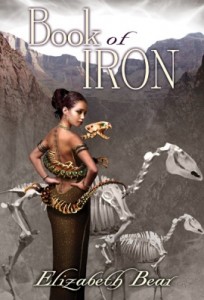
Book of Iron by Elizabeth Bear

Friends are the family we choose, a maxim that lies at the heart of this short but sharp novella, which ties in to Bear’s Eternal Sky novel series. Bijou the Artificer (first met in 2010’s Bone and Jewel Creatures, here young and eager for adventure) joins the immortal Maledysaunte on a quest to the abandoned city of Ancient Erem to stop Dr. Liebelos, a precisian (wizard of orderliness), from summoning the Iron Book. With them go a crew of allies with mixed motives, including Kaulas the Necromancer, who is Bijou’s lover and rival, and the wizard Salamander, Maledysaunte’s companion and daughter to Dr. Liebelos. Under skies whose moons and suns vary in number, they must confront the threats of legendary beasts and betrayal. Bear injects the fizz of the Roaring ’20s (including travel by roadster, automatic pistols , aeroplanes, and silent movies) into a thoughtful exploration of dealing with loss. — Publishers Weekly

« Previous EntriesNext Entries »